
AI may not deliver irrigation performance gains
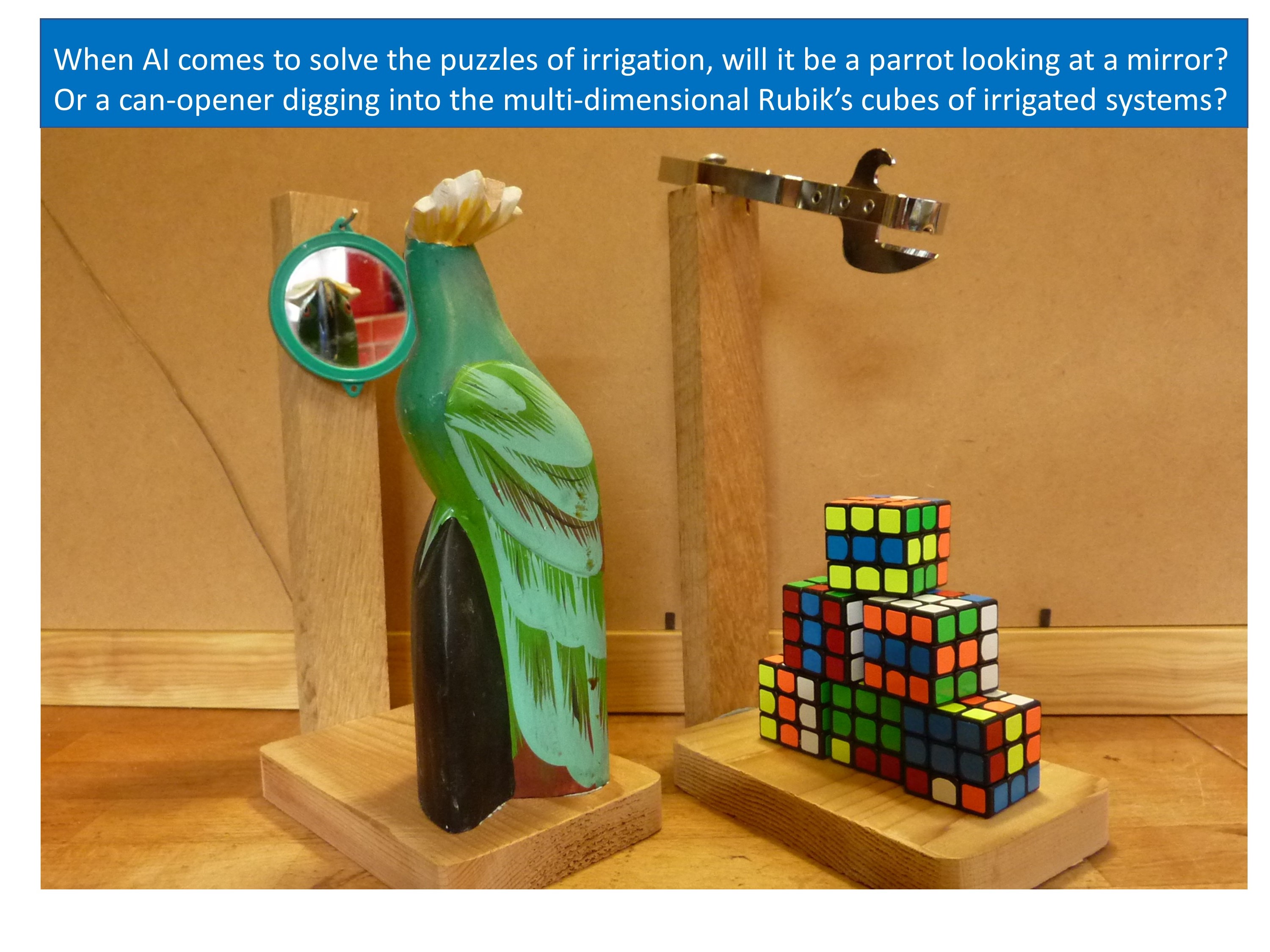
On the 5th June 2025 meeting of the Tony Allan Society, I argued that AI employed by irrigation scientists will not help us deliver significant analytical breakthroughs and improvements in local-to-global irrigation performance. In my allotted 10 minutes and in this short blog, I give the below five concerns, which spring from three premises:
• First I understand that, through online applications such as ChatGPT, AI is a collator and scraper of internet-available information rather than as a true independent and original thinker (Bender and Hannah, 2025).
• The second premise is that irrigated systems are true real-world systems; complicated, nth-dimensional, and each highly unique (Lankford et al, 2020; Lankford 2023). To lift their performance requires deep, penetrating and sustained empirical action-research at multiple scales over time.
• The third premise is that this high-quality research is not happening globally, and has not happened for over three decades. The lack of irrigation action-research is unable to inform AI scrapers.
My test of AI to help me critique it
Disclaimer: I am not a seasoned user of ChatGPT and similar AI portals. In my test I asked Anthropic Claude AI via its “Help me understand a complex topic from scratch” two questions. Its answers can be downloaded from my two questions: “Please tell me how to improve the performance of gravity surface irrigation systems” and “Please explain to me the irrigation efficiency paradox”. Anthropic Claude AI did a better job than I expected – although in the paradox answer it reproduces simplistic explanations and calculations that I think are unhelpful in the real world of irrigated systems (Lankford, 2023) . However this blog and my talk are not to extol the virtues of AI or to closely analyse the results. My doubts persist, as I now explain.
Parroting a mirror? Or can-opening Rubik’s cubes? From these three premises and from my test, I see AI as a parrot looking at a mirror, rather than as a can-opener inviting us to crack open multi-dimensional Rubik’s cubes of complex irrigated systems. The parrot is the AI machine and the mirror is the thin abstract model of irrigation systems represented by slim explanations available on the internet. N.B. I built my parrot-mirror model (see photo) in April 2025 only to later discover that Emily Bender describes AI as a ‘stochastic parrot’ using computer power to repeat things on the internet.
My five interrelated concerns are:
- Tail-end irrigators, maize plants, field furrows, drip emitters and canals are not uploading to the internet (and neither should they). In our move towards digital AI-enabled data-rich irrigation management, how will AI garner, let alone make sense of, the paucity of data from / at the bottom scale and tail-end of irrigation systems when these don’t spend time loading up data, information and knowledge to the net? By this I mean the vast majority of what constitutes irrigation systems and their internal variability. Marginal tail-end farmers and lowly gate-keepers come to mind, and things like individual crop plants, field hollow spots, spile pipes, canal outlets and soil pedons, to mention a few more. More intangible components of irrigation systems are also usually missing such as budget-spends and ad-hoc informal agreements. Also, you can see in the two AI responses, that people and institutions are largely absent, and any comparative variations within an irrigation system that might inform us how to proceed do not exist. Biological entities and inanimate objects would have to be equipped with countless sensors in order to represent the true behaviour of systems covering thousands of hectares. Put another way, there are not enough sensors in the world to triangulate remote sensing and/or accurately schedule water across 350 million hectares of irrigation no matter how strongly international organisations put their faith in these tools. When it comes to representations of irrigation systems, I subscribe to the Plato’s allegory of the cave; we can never really know their reality. The question is how to build cost-effective irrigation models and practices that understand that reality in order to design-in data-lo / data-free high irrigation performance. A move towards AI digital irrigation will occlude that ‘out of the box’ question.
- AI will keep clear of the messy middle. It is easy to (mis)characterise the hydrology of irrigation systems as polar opposites ( real or paper savings) or by overly focussing on two scales; field or catchment (Lankford, 2023; Lankford et al 2020). But from the previous point, I doubt AI will naturally gravitate towards the multi-scale nth-dimensional messy-middle that is land, water, crop, people and infrastructure management. As I said above, the responses to my two AI questions reveal what is missing. They omit, for example, how A) fluid negotiations (e.g. shaped by farmer associations and agreements); B) events (e,g, heavy rainfall or severe drought); C) variability (e,g, soil types, geologies and geomorphologies); D) the poor funding environment for irrigation; and E) little-visited technical factors (e.g. rising amounts of operational water storage or low canal densities) inform, or fail to inform, researchers, farmers, and irrigation performance and water consumption. I fear AI cannot guide us on the messy middle, instead it will reinforce journal-article-tendencies to polarise or simplify, simplify, simplify. In my view, AI will not act as a scholarly honest broker to unpick different pathways, or show how will it deal with intrinsic uncertainty, or lead the way on boosting funding for irrigation research and management.
- Whose sanctioned knowledge? Claude AI presented its two responses to my questions as flat universal beguiling truths. There is no or little indication of dissent and lack of consensus between epistemic communities and paradigms. Even those at the top of the debate contradict themselves and confuse the Jevons Paradox as the hydrological explanation of the rebound paradox in water consumption (e.g. Perry et al, 2023 contrasted with Perry 2019), leading to yet more misunderstandings in irrigation hydrology. I do not believe AI can weigh these disagreements especially when influential parties repeat their simplifications backed by considerable power (e.g. FAO’s slim REWAS savings calculator vs the detailed spreadsheets from ol’ retired independent Bruce).
- On systems field-based inquiry, AI is an unreliable partner. Irrigation systems are real-world systems demanding field-based action research at all time and spatial scales. Researchers should be systems-facing, walking the fields, canals, pipes and gates, and working with farmers. Yet the trend for research is towards time-efficient office- and computer-based inquiry which AI will reinforce. I do not see how AI will partner with farmers wishing to resolve a problem but whom might disagree over the nature of that problem. I fear AI simply parrots sanctioned expert knowledge, much of which is ill informed about irrigation, in rendered-down bullet points. AI may not be able to read unique context-specific irrigation systems, guide bespoke tailored revitalisation programmes, give us entry points on remedial actions, or navigate between nostrums; “modernise irrigation as this saves water” or “don’t modernise irrigation as this increases water consumption”. Unpacking these grey areas is why I prefer my irrigation marbles game as one method for both problem elucidation and irrigator empowerment.
- AI is inside the box, not outside. By parroting the main actors and winners of irrigation debates from the last 30-40 years, and by being a seemingly confident rejoinder to a specific inquiry (see my two examples), AI is unable to step outside of the problem. It is unable to deliver divergent thinking and problem discovery regarding complex systems (e.g. Cooperrider, 2008) – or remind the inquirer that irrigation systems are more likely characterised by non-linear, open-ended plural and post-normal thinking. Claude AI did not ask me back “what is the concern behind your inquiry? or “who is asking?”. For example, irrigation systems are also social/resilience systems providing ecosystem services to a variety of actors (e.g. Cox, 2014). This socio-ecological emphasis would generate an entirely different AI answer on ‘irrigation performance’. Second, AI did not step out of the irrigation management box. For example, it did not inform me about potential global governance frameworks to raise irrigation performance on a global scale (for ideas on this in Lankford et al, 2016. NB. I did ask Claude AI about this topic and was given a description of trends towards small-scale investments and current actors such as FAO, ICID, World Bank etc.). Third, AI fits with and invites a data-rich digital paradigm. This is fine for individual research projects, but scientists working on AI and irrigation are not debating the question raised in the first main point above; how do we manage global irrigation well without resorting to water measurement and monitoring? Fourth, to technically exemplify what I mean by stepping outside of the box, my first paper (Lankford, 1992, written after working for five years on an irrigation system in the drought-prone Eswatini (Swaziland) lowveld), does not refer ‘irrigation efficiency’ as the key convening idea or means to raise irrigation performance. Arguably, we have been misdirected for the last 30-40 years by engineers and economists besotted with the pros and cons of irrigation efficiency rather than the more important question of ‘how to deliver manageable accurate water control on gravity irrigation systems?’.
Summary; “scrape my gems”. I accept, if used carefully, AI can be part of a future ecosystem of computer-aided functionality (drawing on sensors, satellite data, digital twins and the IoT) to aid irrigation management. However claims of computers benefitting irrigation O&M have made for more than three decades (e.g. Verdier, 1987) whilst the global performance record of gravity irrigation has remained at a relatively low equilibrium. The reasons for this are a discussion for another day.
However, if we are not careful, AI will reinforce the trend for knowledge and power to move away from field-walking researchers, irrigators and groups of irrigators towards and up to office-based interns, experts and expert-parroting farmers drawn by the promise of remote computer-aided analysis. Equally, I am critical of AI answers that ‘describe the what’ rather than ‘explain the how to proceed’ – especially in data deserts where monitoring of surface water flows is rare or absent. And I am worried that AI-using irrigation researchers will claim their slim mirror of irrigation is, in fact, the nth-dimensional pyramid of Rubik’s cubes of irrigation, thus negating the need for a deeper debate about irrigation.
As a semi-retired academic with 40 years’ experience in irrigation (which included many rookie errors), I am losing the science-war and Darwinian race for who is informing AI and the digital/data world this invites. My gems on irrigation (such as they are), but moreover my system- and farmer-facing philosophy on manageable high-performing water control, are not being scraped by ChatGPT and its fellow bots.
To cite this post: Lankford, B. A. (2025). AI may not deliver irrigation performance gains. Blog at https://brucelankford.org.uk/2025/05/29/ai-may-not-deliver-irrigation-performance-gains/
Citations
Bender, E., & Hannah, A. (2025). The AI Con: How to Fight Big Tech’s Hype and Create the Future We Want. HarperCollins.
Cooperrider, B. (2008). The importance of divergent thinking in engineering design. 2008 Pacific Southwest Section Meeting, https://peer.asee.org/52262.pdf
Cox, M. (2014). Applying a Social-Ecological System Framework to the Study of the Taos Valley Irrigation System. Human Ecology, 42(2), 311-324. https://doi.org/10.1007/s10745-014-9651-y
Lankford, B. (1992). The use of measured water flows in furrow irrigation management – a case study in Swaziland. Irrigation and Drainage Systems, 6, 113-128. https://doi.org/https://doi.org/10.1007/BF01102972
Lankford, B., Makin, I., Matthews, N., McCornick, P. G., Noble, A., & Shah, T. (2016). A compact to revitalise large-scale irrigation systems using a leadership-partnership-ownership’theory of change’. Water Alternatives, 9(1), 1-32. http://www.water-alternatives.org/index.php/alldoc/articles/302-a9-1-1/file
Lankford, B., Closas, A., Dalton, J., López Gunn, E., Hess, T., Knox, J. W., van der Kooij, S., Lautze, J., Molden, D., Orr, S., Pittock, J., Richter, B., Riddell, P. J., Scott, C. A., Venot, J.-p., Vos, J., & Zwarteveen, M. (2020). A scale-based framework to understand the promises, pitfalls and paradoxes of irrigation efficiency to meet major water challenges. Global environmental change, 65, 102182. https://doi.org/https://doi.org/10.1016/j.gloenvcha.2020.102182
Lankford, B. A. (2023). Resolving the paradoxes of irrigation efficiency: Irrigated systems accounting analyses depletion-based water conservation for reallocation. Agricultural Water Management, 287, 108437. https://doi.org/https://doi.org/10.1016/j.agwat.2023.108437
Perry, C. (2019). Will Irrigation Technology, Pricing, or Quotas Ensure Sustainable Water Use? In T. Allan, B. Bromwich, M. Keulertz, & A. Colman (Eds.), The Oxford Handbook of Food, Water and Society. Oxford University Press. https://doi.org/10.1093/oxfordhb/9780190669799.013.2
Perry, C., Allen, R., Droogers, P., Kilic, A., & Grafton, Q. (2023). Water Consumption, Measurements, and Sustainable Water Use (Technical Report). Global Commission on the Economics of Water 2023 Paris.
Kaune, A., Droogers, P., van Opstal, J., Perry, C., & Steduto, P. (2020). REWAS REal WAter Savings tool: Technical document (FutureWater Report 200). https://www.futurewater.nl/wp-content/uploads/2020/06/FAO_REWAS_v08.pdf
Verdier, J. (1987). Computerised control of irrigation water distribution. ODI/IIMI Irrigation Management Network Paper 87/1d.
 Bruce Lankford