
The commons are morphing into the paracommons
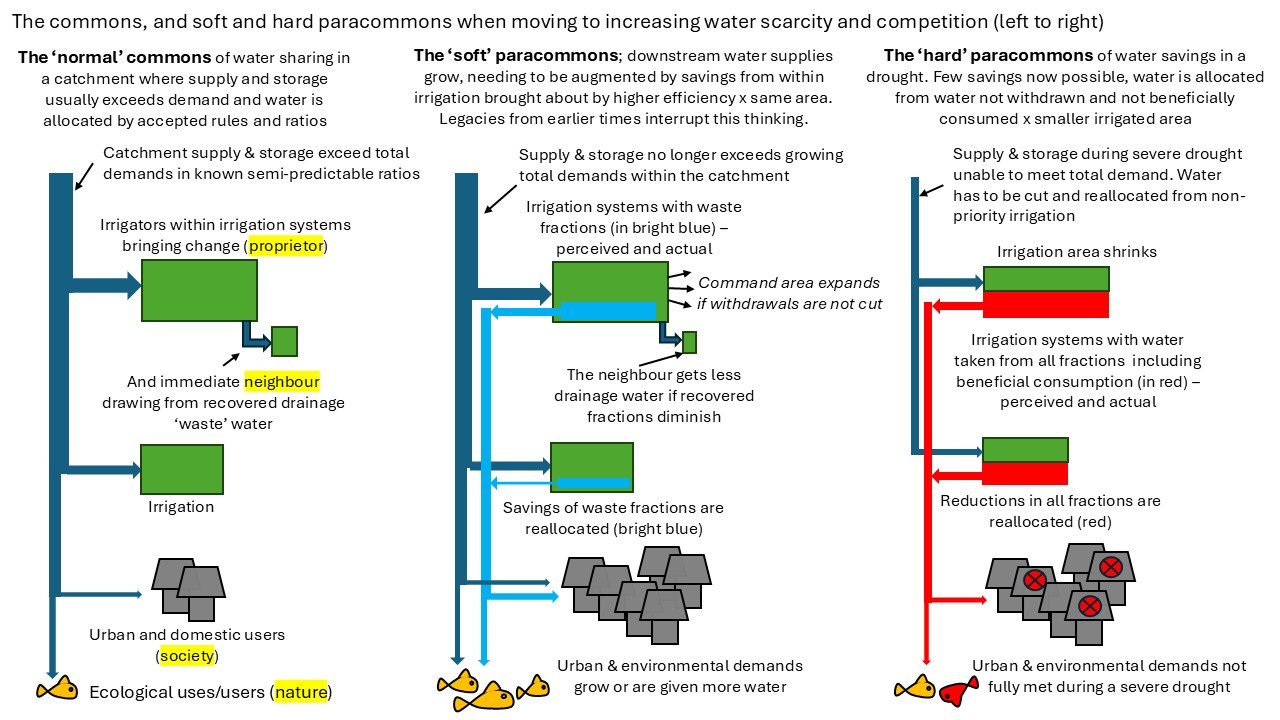
Summary. With sharpening water competition, especially during drought, inadequate water supplies to meet rising demands express as resource redistribution between users. Under these conditions, the commons of water morphs into the paracommons where competition arises for resources believed to be available if ‘freed up’ from saved wastes and excesses. However, in the ungoverned and misunderstood space of irrigated hydrology, contested outcomes differ considerably from expectation, a key feature of the liminal nature of the paracommons. Furthermore, as scarcity intensifies and irrigation becomes more frugal, and savings of wastes less easily accessible, the prospect of a hard paracommons looms. This is when cuts to all fractions including net beneficial consumption – a version of shrinkflation – become necessary to reallocate that water to priority uses elsewhere. The commons, soft paracommons and hard paracommons are compared in the diagram above.
The commons of water… frames rivalrous users sharing a limited water supply e.g. irrigators in an irrigation canal system, or irrigation systems sharing a catchment or aquifer. The idea of a rivalrous commons was founded during an era of greater resource sufficiency than today (Ostrom, 1990) where supplies and storage usually exceeded withdrawals (abstraction). This gave varying, tight but accustomed ratios of supply-to-demand that were negotiated between users in the areas and sectors supplied. The left-hand side of the diagram above shows a conventional water commons found across and within a river basin (catchment) when total supply exceeds total demand.
The paracommons arises because… there is no headroom between supply and demand leading to actors inside or outside of resource-use area believing wastefully used resources, if saved and freed up, are available for their or other sectors. The paracommons is a commons of reified or regained waste and wastages; it asks who gets the material gain of an efficiency gain (Lankford, 2013). In the diagram, the four paracommoners competing over these gains (or indeed reductions) are the proprietor driving the efficiency gain, an immediate neighbour, nature and society. Mathematically, the paracommons arises because of the difference – or delta – between today’s higher aggregate consumption (depletion) and tomorrow’s lower aggregate consumption. More conceptually, the paracommons presents because of gaps and misunderstandings; a) the narrative of irrigated systems being inefficient and wasteful is crucially under-researched and over-simplified; b) the actual today is highly complex, comprising non-recovered and recovered fractions, and beneficial and non-beneficial consumption; c) an idealised prefigured less-consumptive tomorrow rarely arrives; d) tomorrow’s new distributions arising from efficiency changes are difficult to predict, map and account for (Lankford and Scott, 2023); and e) reducing water consumed in irrigation whilst simultaneously maintaining or boosting crop production is difficult (Lankford et al., 2025, Lankford and McCartney, 2024). In other words, the paracommons deals with resources that are usually poorly measured and not tracked, and are best understood as liminal, contested and fluxing trade-offs (Lankford, 2018) driven by on-going changes in supply, demand and technology.
The commons are morphing into the paracommons. Three interconnected trends have set the conditions for the commons to become more paracommons-like. First, water demands from all sectors and users such as irrigation, cities and the environment are increasing. This means little headroom between supply and demand exists, even during normal-to-wet years. Second, drought and warming brought by climate change. During drought, users accustomed to sharing water in normal-to-wet years have to learn how to – and make – drastic cuts in their water consumption (Lankford et al., 2023). These cuts result in even greater competitive trade-offs between users. Furthermore, the smaller the headroom in normal-to-wet years and the longer the drought, the more significant the trade-offs and the less any water storage mitigates drought. Third, is the widespread belief that technologically-driven demand management can easily release water for reallocation (van der Kooij et al., 2017). For example, converting supposedly inefficient canal irrigation systems to supposedly efficient drip irrigation is expected to free up large amounts of wasted water.
From the soft paracommons to the hard paracommons. As well as the commons morphing into the paracommons, allocation choices in the soft paracommons become starker as scarcity sharpens leading to the hard paracommons. Difficult choices arise when one user’s beneficial fraction has to be reduced to free up resources for another user. Imagine an irrigator asked to save water by reducing losses; this is the soft paracommons. Yet during a severe drought, the same irrigator may have to ‘save water’ by cutting their irrigated area, in other words from their beneficial crop ET – harming crop production. This non-withdrawn, non-consumed water can now be reallocated to others, or kept in a storage dam for later use. This is the hard paracommons.
(The poorly understood space of irrigation efficiency is a defining part of the paracommons, but this blog does not to revisit the debate surrounding irrigation efficiency and savings, and their confusions and paradoxes. Although well-rehearsed in the literature, these confusions are often not backed by empirical data, sound explanation or hydrological knowledge – and are situated in a wider vacuum of poor irrigation governance and research. Rather, the purpose of this blog is to argue the commons is entering into an era of the soft and hard paracommons.)
Acknowledgements – The author is grateful to Saskia van der Kooij, Patrick Hoffmann, Sergio Villamayor-Tomás and Brice Ehmig for discussions that led to this blog.
LANKFORD, B. 2013. Resource Efficiency Complexity and the Commons: The Paracommons and Paradoxes of Natural Resource Losses, Wastes and Wastages, Abingdon, Routledge.
LANKFORD, B., AMDAR, N., MCCARTNEY, M. & MABHAUDHI, T. 2025. The iGains4Gains model guides irrigation water conservation and allocation to enhance nexus gains across water, food, carbon emissions, and nature. Environmental Research: Food Systems, 2, 015014.
LANKFORD, B., PRINGLE, C., MCCOSH, J., SHABALALA, M., HESS, T. & KNOX, J. W. 2023. Irrigation area, efficiency and water storage mediate the drought resilience of irrigated agriculture in a semi-arid catchment. Science of The Total Environment, 859, 160263.
LANKFORD, B. A. 2018. The Liminal Paracommons of Future Natural Resource Efficiency Gains. In: AMIN, A. & HOWELL, P. (eds.) Releasing the Commons. Rethinking the futures of the commons. 1st Edition ed. London: Routledge.
LANKFORD, B. A. & MCCARTNEY, M. 2024. Managing the irrigation efficiency paradox to “free” water for the environment. In: KNOX, J. W. (ed.) Improving water management in agriculture: Irrigation and food production. Cambridge Burleigh Dodds Science Publishing Limited.
LANKFORD, B. A. & SCOTT, C. A. 2023. The paracommons of competition for resource savings: Irrigation water conservation redistributes water between irrigation, nature, and society. Resources, Conservation and Recycling, 198, 107195.
OSTROM, E. 1990. Governing the commons: The Evolution of Institutions for Collective Action, Cambridge, Cambridge University Press.
VAN DER KOOIJ, S., KUPER, M., DE FRAITURE, C., LANKFORD, B. & ZWARTEVEEN, M. 2017. Re-allocating yet-to-be-saved water in irrigation modernization projects. The case of the Bittit Irrigation System, Morocco. In: VENOT, J.-P., KUPER, M. & ZWARTEVEEN, M. (eds.) Drip Irrigation for Agriculture. Untold Stories of efficiency, innovation and development. Oxford, UK: Earthscan, Routledge.

