
Irrigation is colonising water and is being colonised; on research and teaching gaps in irrigation
I reflect on the current lack of meaningful irrigation research and teaching, and three consequences of this inaction. These are personal reflections spurred by being part of Lankford and Mabhaudhi (2024), Lankford and Agol (2024), the green/blue water Water Alternatives blog, from recent chats/emails with Chyna Dixon, Philippe Floch, Doug Merrey, Stu Orr and colleagues from the Wageningen University Water Resources Management Group and from IWMI.
Before I begin, five things. 1) This blog is mainly about the millions of hectares of irrigated field crops (rice, maize, oilseeds, pulses, sugarcane) not easily amenable to drip irrigation. 2) I appreciate there is a lot irrigation research being conducted by many different people and organisations – but this is a fraction of what is needed, especially action-research of irrigated systems that is co-ordinated, long-term, spans field to catchment to global scales, and encompasses all technical, economic, legal, social, policy and political dimensions. 3) This blog is not about irrigation crashing the party of other water concerns (e.g. delivering WASH, managing aquatic ecosystems). But when those concerns are affected by water scarcity and allocation in the global south then this blog points out that irrigation, consuming some 5-7 km3/day water globally (~600 mm/pa depleted across ~350 million hectares, divided by 365) has many roles and effects. 4) Beyond broad suggestions for the future of irrigation research and teaching, this already long blog does not go into details. 5) Although I acknowledge they are important, I do not analyse other underlying drivers behind the growth in irrigation over the last 100 or more years – such increases in population both globally and in nations that have a rice-based diet.
Irrigation research and capacity building are not needed
One could argue that irrigation research and capacity building are not occurring because they are not needed. This happens in three ways. First, we don’t need serious irrigation research and capacity building because irrigation is not significant nor is it a complicated system. In other words, irrigation; can easily be characterised and rolled out (and presumably easily be rolled back); doesn’t impact on water; is ‘only infrastructure’ (a bit like roads – see below); is eclipsed by the significance of green water, AI, WASH, or other latest concern – and can therefore be ignored or demoted; and can be adopted by a charity or think-tank but in a cursory way. For example, the topic of ‘regenerative agriculture’ in irrigation is being promoted for its land and water benefits, often without its difficulties and paradoxes being considered (Lankford and Orr, 2022). To further illustrate, I’m bewildered by global reports on the state of rivers, WASH or food security that neglect the water-consumptive, -redistributive and -productive roles of approx 350 million hectares of irrigation in shaping freshwater scarcities, especially in non-temperate climates of the world. If I read one more communique that calls for action on drying rivers but largely skirts over irrigation, or a flagship report on the future of food production that (mis)directs its audience towards smart vertical farming and forthcoming halophyte vegetables… Agreed, not every study needs to cover irrigation, but its frequent omission is telling. Donors, reading these global reports and pondering over their next spending programme, are not being reminded, from all sides, why the ‘impacts and performance of irrigation’ is a significant problem worth funding.
Second, we don’t need irrigation research because we already have the answers. There are many irrigation procedures, logics and solutions to choose from. These include; add drip, smart or efficient irrigation, add supplementary water, add solar, use remote data, use soil probes, add more storage, irrigate at night, reuse wastewater, laser-level fields, line canals, use deficit irrigation, use alternate-row irrigation or alternating wet-and-dry irrigation or surge irrigation, introduce meters and pricing, train farmers on water, apply water rights, focus on the spectrum of agricultural water management, harvest more rainfall, use green (or grey) infrastructure, apply water accounting, and use FAO’s CROPWAT for irrigation planning. Often forgetting other factors that affect irrigation (such as energy subsidies and urban competition for land), everybody knows how to technically fix irrigation, so why bother researching or teaching it.
Third, we don’t need irrigation research because “we don’t need more research, we need action!”. This view is related to the first and second views; it is predicated on the idea that irrigation is not a complex puzzle that unquestionably demands research. However, sympathetic to the need for action, we need more system-encompassing action-research, and perhaps fewer single-scale single-topic studies.
Irrigation research and capacity building are needed
Irrigation research and capacity building are needed to make sense of the above solutions and omissions (Lankford, 2022, Lankford and Mabhaudhi, 2024), and to prepare for a much more water-scarce world, and to do so in a locally, regionally and globally co-ordinated way. The above fixes are not necessarily wrong, but they can become silver bullets. They can be applied piecemeal or to one scale (e.g. the field or the global, as in a map of hotspots) without being integrated and contextualised within a cross-scale wider system. They can be diluted by being bundled into broader conceptual framings (that usefully bring together different actors and sectors) but struggle to be operationalised. Plus there are legacy formulations that come from an earlier era of water abundance which need to be brought into our water-scarce era – think of prior appropriation water law in the Western USA, or FAO’s irrigation planning computations (see Lankford, 2004). The latter computations, deep-seated within irrigation design, act as unintended levers on water allocation (Hooper and Lankford, 2018).
Competent research and skills are needed to study wicked problems such as the water management and productivity of large-scale canal schemes or large areas of coalesced smaller farms. In irrigated catchments facing rapid changes in water competition, climate, urbanisation, market economics and agricultural policy, we need research on the thorny problem of how to sustain total crop production while conserving and reallocating irrigation water (Lankford, 2023). For these and other multi-scale challenges, solutions should be tested at scale in diverse systems during wet seasons, dry periods and drought. Action-research should build on farmers’ artisanal infrastructure, on their group knowledge and rules, and on reflexive circular learning (farmer-to-farmer-to-system-and-back-again). One benefit of reliably researched, managed and monitored irrigation systems would be a rich empirical understanding of farmers, land, water, crops and climate across time and space. In turn, these data would allow us to calibrate our conceptual and computational models, and develop new ones.
Plus, integrated solutions should stand on decades of published literature and debate about interventions in irrigation. Because commonplace silver bullets come from ‘everybody’, they often fail to mention in-depth ideas that are usually associated with greater irrigation knowledge. Let me give you an example. System-design approaches to achieving higher irrigation performance are found in literature now 30-40 years old – that then were part of a rich debate associated with Lucas Horst, amongst others (Diemer and Slabbers, 1992). The insightful question that guided my PhD on this topic was from Bos (1987); “Water management in future irrigation schemes could be improved if systems were designed in such as way that their proper management would be as easy as the mismanagement of existing systems.” One ‘solution’ from this kind of questioning is that we need to design-in the correct hydromodule.
Therefore, with better irrigation research and teaching, our silver bullets would become discussed, judged, updated, added to, tailored, combined, integrated, woven together, divided apart, sequenced, scaled-out and up, situated, owned, managed, maintained and improved. They would become governed solutions within wider systematic, institutional, technical and political frameworks. Without this wider integrated framing and oversight of irrigation solutions, we get to three consequences – covered next.
The first consequence; irrigation is colonising water
I believe current gaps in irrigation research, teaching and management permit a creeping colonisation of available freshwater resources by irrigation. By this I mean the depletion of water by irrigation will keep growing, leading to increasing competition for scarce water. I think there are three ways this happens – and there maybe more. First, by creating/supporting policies to grow irrigation. Regardless of whether these policies are for farmer-led, supplementary, garden-based, or smart irrigation, they kick-start a growing watering of land (see the Water Alternatives blog). The Malabo Montpellier Panel and the 2005 Commission for Africa are two examples of pro-irrigation policies. Disclosure; I was an irrigation consultant for the Commission for Africa, and tried to advise that doubling the area under irrigation was not sensible and certainly not via treadle pumps. My 2005 report on how to think about irrigation growth in SSA more sustainably is here and also this 2019 ODI report takes a cautious approach.
Second, by looking the other way. Briefing notes and reports that, for example, consider urban or environmental water scarcity, should realise pages not spent highlighting and analysing irrigation are pages that allow irrigation to go unscrutinised. Similarly, text that addresses economic solutions to water reallocation, without surfacing the hidden effects of entrenched irrigation protocols, will be incomplete (Hooper and Lankford, 2018).
Third, by not being comprehensive and integrated with our solutions. The above single technical solutions applied in isolation can unwittingly increase the volume of water depleted by irrigation. This is because these solutions rarely control for five factors; the nature of the technical solution being applied; cross-scale and over-time changes in irrigation hydrology; prior withdrawals carried over despite lower field-scale irrigation doses; incremental increases in farm water supply (e.g. via on-farm ponds, wastewater and boreholes); and changes to irrigating season lengths, crop types, and net and gross irrigated areas. For example, drip irrigation can save water at the field scale, but the continuation of prior water withdrawals and greater on-farm water storage, allows more area to be irrigated and more water to be consumed at the farm and catchment scales (Lankford, 2023). Same with harvesting more rainfall for supplementary irrigation; instead of reducing withdrawals and consumption (as it should do), it allows irrigated areas to expand (Lankford and Orr, 2022), reducing runoff for downstream use. Two other examples; solar irrigation removes farmers’ fuel costs that help regulate groundwater abstraction and depletion; and urban wastewater recycled to irrigation (rather than as treated water back to nature) adds to irrigation’s water depletion.
To reiterate the third point, if silver bullets are not systematically thought-through, managed and governed, they paradoxically allow the physical gains from supply and demand management to fall to irrigation and especially ‘the proprietor’. In my paracommons framing (Lankford and Scott, 2023, Lankford, 2013), there are four parties competing for material gains from an efficiency gain; the proprietor making the gain (and investment), an immediate neighbour affected by the changes in the proprietor, nature and society. This ratcheting-up of irrigation’s consumption stems from well-intended calls to, for example, increase water storage and implement efficient irrigation.
The second consequence; irrigation is being colonised
Who stands to profit from irrigation not being better researched, taught and managed? I am not referring to donors saving time and money because the sector is out of fashion. Rather, I ask who really profits from this absence and these gaps? I think the second consequence is the colonisation of water and irrigation by disciplines, actors and organisations who profit from this lack. This happens in five ways. First; disciplines, actors and organisations gain by building undue influence and authority over the complex subject of water and irrigation without sufficient pushback from the many other disciplines, voices and actors involved in this field. Often this is also achieved by ‘keeping the narrative simple’. Examples include seeing irrigation as infrastructure (like roads, as someone from a UK donor once told me), or interpreting physical irrigation hydrology via economic efficiency. Second; they gain by selling knowledge services (e.g. irrigation data, models, training, policy briefs, consultancies and management) that can be done as short field visits or by sitting at a desk, and that do not match claimed beneficial outcomes at scale and over the long term. Third; they gain by selling inappropriate equipment and infrastructure that will be poorly maintained or eventually stand unused by farmers’ fields. Fourth; they gain through the interest made on money loaned to ill-conceived projects. Finally; they gain territorially by directly investing in new land for irrigation in poorly regulated areas (leading to overt private property grabs rather than paracommons creep).
The second type of colonisation (irrigation being colonised by interests and parties with a limited understanding of irrigation) can excuse and licence the first type of colonisation (the growing use of limited freshwater by irrigation). An example; if a scientific study builds a computational model that (in my view) fails to properly derive real water savings – and strongly promotes it to the detriment of other models, conversations and policies – we run the risk of irrigation consumption continuing to rise. We need more action-research, debate and teaching to build, adopt and adapt models with sufficient explanatory power in order to govern water savings in irrigation (Lankford, 2023).
The third consequence; material harms and poorly evidenced perceptions
While some are gaining from these irrigation gaps, the rest of us are picking up the cost of this inaction. Setting aside donations, borrowings and taxes to pay for projects not supported by comprehensive irrigation research and skills, the costs and harms are well known. Rivers don’t have enough water in them, aquifers are plumbed to greater depths, hectares of irrigation are not producing at levels they could be (though many are), and irrigation-induced water shortages impact other users, sectors and economies.
As well as these harms, there are perception costs. Many cast irrigation, especially surface/gravity irrigation, as inefficient and wasteful. I have no idea where the robust evidence for this is, and I have rarely seen this in my 40-year career, but what I have seen is room for improvement. Also we conveniently put irrigators in a homogeneous box that says ‘they waste water and need training on soils, land and water’. We do not see farmers situated on their fields as individuals puzzling out their system of neighbours, infrastructure, institutions and environmental fluxes. When we work with irrigators (especially tail-end irrigators) as fellow-puzzlers – not guzzlers – we can have an honest conversation with them about their training needs. (My experience of this in Tanzania was that they asked for training on book-keeping – go figure). Both perceptions ‘drip irrigation saves / does not save water’ hold true provided many controlling factors are explicitly understood. The worry is that either view can be championed without any accompanying multi-factor system information – or indeed without debate.
The future of research and capacity building in irrigation
We do not know if irrigation research and capacity building will be properly funded in the future but we already know the killer problem. It is the ‘more crop per drop’ one that IWMI have rightly championed. Irrigation research and teaching is needed to understand fast-changing systems, to move on from legacy or one-off solutions, and to undertake system- and farmer-centred approaches that will sustainably and equitably deliver equal or greater crop production while consuming less land, water and energy. In other words, we should ask for sustainable irrigation, not irrigation (Lankford and Heaton, 2022).
Let me return to the topic of irrigation efficiency and water conservation. This requires uncomfortable debate and empirical research. In a messy wicked world comprising many unique irrigation systems, we need to put irrigation efficiency (IE) into service in a thoughtful way alongside other determining factors such as command area, storage and the rules dictating changes to water withdrawals (Lankford, 2023). The two polarised views about irrigation efficiency (higher IE leads to less / more water being consumed) are built on simple logics and the lack of empirical research across many scales – which is difficult to do (emailed-out questionnaires don’t cut it). By stripping out complexity, both views allow irrigation’s water use to keep growing.
Summarising
Because many consultants, analysts, researchers, research projects, funders and decision-makers are not fully interrogating irrigation as a complex system, irrigation is colonising freshwater, and it is being technically, conceptually and financially colonised.
‘A vacuum is always filled’, goes the adage. This is what is happening to irrigation. It is a growing vessel into which we pour one-off single-scale solutions and simple logics. We watch this vessel as others fill it, ignore it, break it, walk off with it, or tell you it is something else.
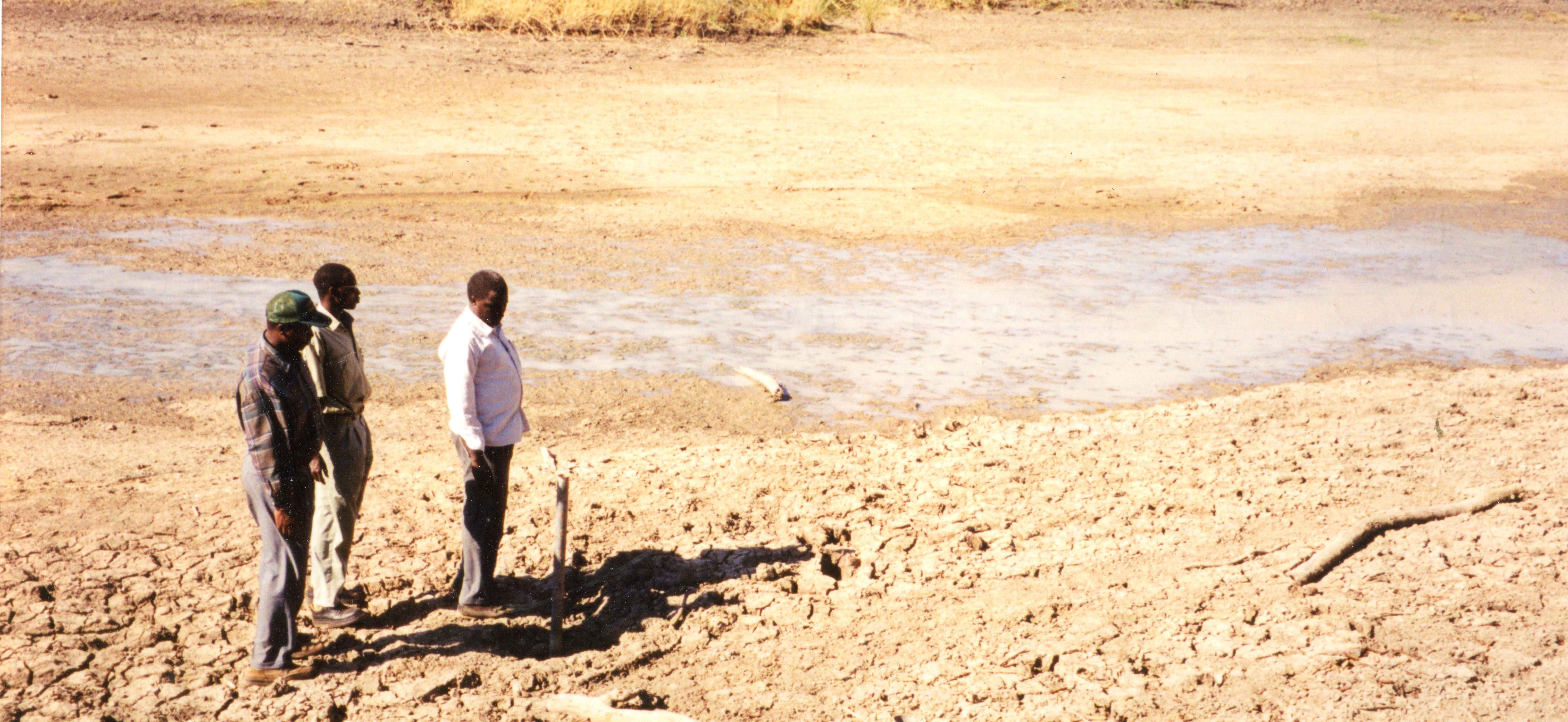
Above photo credit: Bruce Lankford. Drying of the Ruaha, Tanzania, downstream of irrigation in 1999.
To cite this: Lankford B. A. (2024). Irrigation is colonising and is being colonised; on research and teaching gaps in irrigation. https://brucelankford.org.uk/2024/10/22/irrigation-is-colonising-water-and-is-being-colonised/
References
Bos M. G., 1987. Water management aspects of irrigation system design, in Irrigation design for management Asian regional symposium, Volume II, Discussions and Special Lectures, Kandy, Sri Lanka, 16-18 February 1987. Hydraulics Research, Wallingford, UK, pp.67-76.
Hooper, V. & Lankford, B. 2018. Unintended Water Allocation: Gaining Share from Indirect Action and Inaction. In: Conca, K. & Weinthal, E. (eds.) The Oxford Handbook of Water Politics and Policy. Oxford University Press. https://doi.org/10.1093/oxfordhb/9780199335084.013.32
Diemer, G., & Slabbers, J. (1992). Irrigators and engineers: Essays in honor of Lucas Horst. Thesis Publishers 1992.
Lankford, B. 2004. Resource-centred thinking in river basins: should we revoke the crop water approach to irrigation planning? Agricultural Water Management, 68, 33-46. https://doi.org/10.1016/j.agwat.2004.03.001
Lankford, B. 2013. Resource Efficiency Complexity and the Commons: The Paracommons and Paradoxes of Natural Resource Losses, Wastes and Wastages, Abingdon, Routledge.
Lankford, B. & Mabhaudhi, T. 2024. A proposal for an academy to deliver capacity building in agricultural water management with particular reference to irrigation. Irrigation and Drainage. https://doi.org/10.1002/ird.3015
Lankford, B. & Orr, S. 2022. Exploring the Critical Role of Water in Regenerative Agriculture; Building Promises and Avoiding Pitfalls. Frontiers in Sustainable Food Systems, 6. https://www.frontiersin.org/article/10.3389/fsufs.2022.891709
Lankford, B. A. 2022. Irrigated agriculture: more than ‘big water’ and ‘accountants will [not] save the world’. Water International, 47, 1155-1164. https://doi.org/10.1080/02508060.2022.2088650
Lankford, B. A. 2023. Resolving the paradoxes of irrigation efficiency: Irrigated systems accounting analyses depletion-based water conservation for reallocation. Agricultural Water Management, 287, 108437. https://doi.org/10.1016/j.agwat.2023.108437
Lankford, B. A. & Agol, D. 2024. Irrigation is more than irrigating: agricultural green water interventions contribute to blue water depletion and the global water crisis. Water International, 1-22. https://doi.org/10.1080/02508060.2024.2381258
Lankford, B. A. & Heaton, M. 2022. Ask for sustainable irrigation, not irrigation. Available from: https://nisd.ac.uk/ask-for-sustainable-irrigation-not-irrigation/ [Accessed 8 June 2024 2024].
Lankford, B. A. & Scott, C. A. 2023. The paracommons of competition for resource savings: Irrigation water conservation redistributes water between irrigation, nature, and society. Resources, Conservation and Recycling, 198, 107195. https://doi.org/10.1016/j.resconrec.2023.107195
 Bruce Lankford